A chave para abrir a porta a uma infinidade de métricas de status do projeto é o Valor Ganho (EVM). Esta é uma maneira de colocar um valor no progresso do trabalho alcançado. Mas como é obtido/ganho o valor especificado?
Muito na gestão do valor ganho (EVM) depende do valor
monetizado que você coloca em trabalhos realizados ou no progresso em
entregáveis.
Vamos apresentar brevemente o valor ganho para suportar o EVM
mais simples.
Gestão do Valor Ganho
A EVM é uma maneira de quantificar o progresso do projeto com
comparação do progresso real com o progresso planeado e o custo real gasto. A
EVM desloca estrategicamente o ponto de vista de planeado versus real (acompanhamento
tradicional usado em organizações não-EVM) para planeado versus ganho versus
real.
Valor Planeado
A maioria dos projetos vem com orçamentos. Portanto, mudar a
perspetiva dos entregáveis planeados, o valor planeado não é um salto
particularmente difícil de fazer. O valor planeado é o orçamento ou o custo
acordado do projeto e como ele será gasto ao longo do tempo.
Um conceito fundamental no EVM é que o trabalho vale o valor
planeado (orçamento) do trabalho. O valor planeado simplesmente indicado é
quanto valor você planeou ganhar num determinado momento. Por exemplo, você
planeou gastar 6000 € para instalar um gerador diesel num barco. O valor planeado
é, portanto, de 6000 €. Por definição, quando esse trabalho estiver 100%
concluído, valerá 6000 € para o projeto.
Valor Ganho
O valor ganho mede o progresso entregue em termos monetários
(valor do trabalho realizado), e isso permite que o gestor do projeto
quantifique o progresso como um valor monetário. Qual a utilidade disto? Uma
vez que pode colocar um valor monetário no progresso alcançado, pode compará-lo
com o valor planeado e o custo real. Esta mudança de perspetiva de percentagem de
conclusão para o valor do trabalho realizado ou do valor ganho é uma mudança no
pensamento que contribui significativamente para a análise EVM.
O valor ganho é uma forma de colocar um valor monetário no
progresso do trabalho alcançado. A métrica de valor ganho é fundamentalmente um
valor total percentual em euros. Em vez de dizer que uma entrega foi completada
numa data especificada, o valor ganho diz um valor em termos de um montante em euros
do projeto concluído numa data especificada. O valor ganho indicado
simplesmente é quanto valor foi ganho efetivamemnte no projeto num determinado
momento.
De novo, é uma mudança no pensamento para medir o progresso
entregável em termos monetários (valor do trabalho realizado). Isso
permite-nos traçar e comparar as três métricas (valor planeado, valor ganho e
custo real) num único gráfico, o que, novamente, abre a porta para a análise
que de outra forma, não é possível. Assim,
pela medida do progresso entregável em termos monetários (valor do trabalho
realizado), é possível projetar ou sobrepor o progresso do trabalho no mesmo
gráfico que o custo orçamentado e o custo real, o que aumenta
significativamente a possibilidade de métricas disponíveis.
Gráfico de Custo
Vamos em primeiro lugar decifrar a situação de agendamento a
partir de um gráfico de custo e, em seguida, adicionar o valor ganho para mostrar
como a adição do valor ganho proporciona uma melhor compreensão da situação verdadeira
do plano. Na Figura 1, temos um gráfico de orçamentado versus custo real ao longo do tempo ou plano de
despesa versus de fundos gastos.

Figura 1
O custo orçamentado é o valor planeado do trabalho do
projeto. Novamente, pense em termos de valor ou em termos económicos. Este
gráfico mostra que os custos reais do projeto são significativamente menores do
que os custos orçamentados. Parece que tudo está bem com o projeto - parecemos
estar subestimando. Mas o que essa trama nos informa sobre o trabalho real
concluído? Não muito; A percentagem do orçamento gasto ou o custo real não
equivalem à percentagem do projeto completo. "A percentagem do gasto não é
percentagem do feito". Então, ainda estamos no escuro em relação à situação
de status.
Gráfico de Custo e de Valor Ganho
Agora vamos adicionar o valor ganho a essa trama para obter
mais informação; o valor ganho contabiliza quer o custo do projeto como a
situação de trabalho alcançada para colocar o valor no trabalho realizado. Este
custo do projeto e a medição de progresso entregável em termos de euros fornece
a valiosa terceira etapa, figura 2, para os lotes de custo orçamentado e custo real.

Figura 2
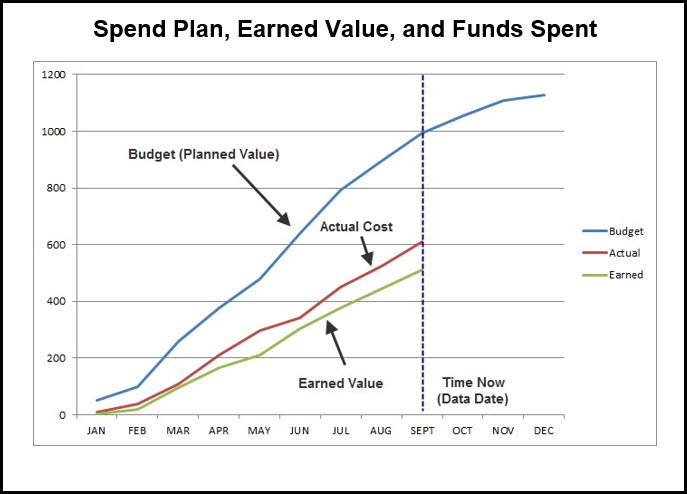
Quando adicionamos uma percentagem de conclusão em euros ou valor
ganho para a nossa trama, observamos que a situação do cronograma real não é
boa. O valor obtido a partir de setembro é significativamente menor que o custo
orçamentado, então estamos atrasados. E o valor ganho a partir de setembro é
menor do que o custo real, então nossa taxa de uso dos fundos do projeto é
maior do que a taxa de progressão entregável; Estamos sobre o orçamento no
trabalho concluído. O lote de valor gano revelou a verdadeira situação do projeto, o que não é bom.
O gráfico de exercício mostra o valor em traçar a métrica de
valor ganho e os custos em conjunto. Fornece uma visão de cronograma muito
melhor e permite que uma análise que de outra forma não seria possível. A
intenção aqui não é listar as muitas métricas de medição de valor ganho que
ficam disponíveis a partir deste gráfico de três elementos. Essas métricas de gestão
do valor ganho estão resumidas no Cartão
de Ouro de Gestão de Valor Ganho da Defense Acquisition University.
Por enquanto queremos somente apreciar melhor o valor obtido
ao discutir um projeto. No projeto de demonstração, acordou um contrato para
construir 4 Quilómetros de via férrea por 400 mil em quatro meses com um
contratado. No final de 3 meses, o contratado completou apenas 2 milhas de via
com um custo de US $. ~
O gráfico apenas considera os custos orçamentados e reais,
então dirá que no final de três meses você está 50.000 € acima do orçamento.
Você gastou 350.000 quando foi orçado para gastar apenas 300.000. Mas esta
análise apenas considera custos planeados e custos reais. O valor do trabalho
alcançado não é considerado. O valor ganho considera o custo e o âmbito do
trabalho alcançado em conjunto.
A análise do valor ganho diz que, a cada mês, devem
"ganhar" 100 mil se estiverem no alvo por custo e cronograma.
Infelizmente, em 3 meses eles apenas completaram 2 milhas de trilhos, pelo que
seu valor ganho é de apenas 200.000. Bem, eles gastaram 350.000, então eles
estão acima do orçamento em 150.000 e não 50.000. Também só completaram 2
milhas de trilho quando o programado para completar era 3 milhas, então estão
atrasados em 100 mil. Esta análise de cronograma é refletida no gráfico de
valor obtido para o projeto ferroviário, Figura 3.

Figura 3
A análise deste gráfico mostra uma variância de custo do
valor real de ganhos de 150.000, o que é 3 vezes mais a variação de custo
quando apenas considerando valores de custo e valor ganho. O planeado para o
valor ganho em Euros é de 100.000. Note que o gráfico também exibe
convenientemente o valor de tempo dessa variação de cronograma, 1 mês.
Sumário
Quando se trata de medir o progresso do cronograma, é comum
considerar o âmbito completo ou os entregáveis submetidos. Se, no entanto,
incluímos tanto o custo quanto o âmbito do trabalho alcançado juntos na medida
de progresso chegamos ao termo útil no agendamento de valor ganho.
A métrica do valor ganho, novamente, é fundamentalmente uma
percentagem de conclusão em Euros. O valor ganho não é simplesmente o dinheiro
gasto; É o valor do euro colocado no âmbito completado. Considere-o como o
dinheiro obtido pelo âmbito concluído. O subcontratado conclui o trabalho e é
compensado monetariamente em conformidade. Essa compensação correlaciona-se com
o valor ganho num momento no tempo durante a vida do projeto.
O projeto é, portanto, compartimentado em pedaços de
trabalho que têm valor monetário e, se completo, valor ganho. O valor ganho,
além do plano de gastos (orçamento) e dos recursos gastos, fornece muita visão
sobre a verdadeira situação do projeto.